
The Complete Guide to Fueling for a Marathon

You've spent months training for this. The early alarms, the long runs, the midweek speed work, the strength sessions, the rest days you had to fight for. By the time race week arrives, your legs are ready. Your plan is dialed in. Your race outfit is picked out.
But if you're like most of the runners I work with, there's still one piece that feels uncertain: your fueling.
How much should you really be eating in the final week? Do you actually need to carb load, and if so, how? What should you eat race morning? How many gels? Will your stomach cooperate?
As a Running Dietitian and Run Coach, I see this every single training cycle. Runners show up to the starting line having trained hard but having never practiced a real fueling strategy.
They bonk at mile 18. They spend half the race looking for a porta-potty. Or they cross the finish line wondering why their legs gave out when their training said they were ready.
Here's the good news: none of that has to happen to you. With the right approach to fueling before, during, and after your marathon, you can show up on race day feeling energized, confident, and ready to run the race you trained for.
In this blog post, I'll walk you through exactly what to eat before, during, and after your marathon, including how to carb load properly in the days leading up to the race, what to eat on race morning, how to fuel on the course without GI issues, and how to recover well in the hours and days after you cross the finish line.
I'm Cortney, a Registered Dietitian and Running Coach, and I work with runners who are ready to stop guessing their way through training. If you want a fueling and training plan built around your exact training phase and goals, that's exactly what we do inside the RunWell Collective.
Why Fueling for a Marathon Matters More Than You Think
A marathon is unlike any other distance. It's long enough to completely deplete your body's glycogen stores, physically demanding enough that even small fueling mistakes compound over 26.2 miles, and mentally grueling enough that dips in energy feel catastrophic when you still have hours to go.
Here's what most runners don't realize: your body can only store enough glycogen to fuel about 90–120 minutes of running at race pace.
That means somewhere between mile 13 and mile 16, you're running on fumes unless you've done two things:
Filled your glycogen stores as fully as possible in the days leading up to the race
Taken in carbs consistently during the race itself
This is why the runner next to you who "looks less fit" sometimes crosses the finish line feeling strong while another runner falls apart at mile 20. It's almost never about fitness at that point. It's about fuel.
Marathon race day nutrition isn't an afterthought to your training plan. It is your training plan. And when you get it right, everything you've worked for over the past 16 weeks finally gets the chance to show up on race day.
What to Eat During Marathon Training
Before we even get to race week, your day-to-day fueling during training matters more than most runners realize. You can't carb load your way out of 16 weeks of underfueling.
During a marathon training cycle, your body is consistently working harder than it is during normal life. Muscles are breaking down and rebuilding. Glycogen stores need to be replenished. Hormones need adequate fuel to function. And recovery, the part of training where you actually get stronger, happens in the kitchen as much as it does on the couch.
What this looks like in practice:
Carbs at every meal and most snacks (not a side dish, but a main feature of your plate)
20–30g of protein per meal to support muscle repair
Adequate fats for hormone health and satiety
Electrolytes on most run days, not just hot ones
Post-run meals within 30–60 minutes of finishing
One of the most common patterns I see in runners who come to me feeling stuck is that they've been eating "healthy" but not enough. Salads at lunch. A protein shake after a long run. Skipping breakfast before early training runs. Their food choices look great on paper, but they're not giving their body what it needs to actually absorb training.
The runners who perform their best during a marathon build cycle aren't the ones restricting the most. They're the ones fueling most consistently.

How to Carb Load for Your Marathon
Carb loading is probably the most misunderstood part of marathon fueling. Runners either skip it entirely because it feels "too indulgent," do it wrong and show up to the start line feeling bloated and sluggish, or try to cram three days of carbs into one giant pasta dinner the night before.
Here's how to do it the right way.
When to Start
Proper carb loading starts 2–3 days before your marathon, not just the night before. One massive pasta dinner doesn't actually move the needle on your glycogen stores. What matters is consistently elevated carb intake over a 48–72 hour window.
How Much
During carb loading, you're aiming for 8–10g of carbs per kilogram of body weight per day. For most runners, that works out to 400+g of carbs daily, which is significantly more than a typical day of eating.
This is where runners get nervous. That's a lot of carbs. But remember, your body is actively storing this fuel for race day. You're not "eating too much." You're preparing.
What to Eat
The best carb loading foods are easy to digest, familiar to your stomach, and relatively low in fiber and fat. This is not the time for a massive bowl of high-fiber whole grains or a cream-based sauce.
Good carb loading options include:
White rice with chicken and a simple sauce
Pasta with marinara
Bagels with honey or jam
Pretzels
White bread or sourdough
Waffles or pancakes
Oatmeal with banana
Sports drinks and juice
Fig bars, granola bars, and cereal
Foods to minimize during carb loading:
High-fiber whole grains (they'll feel heavy)
Large amounts of raw vegetables
Creamy or fried foods
Spicy foods
Anything new your stomach hasn't handled before
The Mistake Most Runners Make
The biggest carb loading mistake I see is that runners do it for one meal instead of several days, then feel disappointed when it doesn't seem to "work." Carb loading is not a pasta dinner. It's a 2–3 day process of strategically filling your glycogen stores.
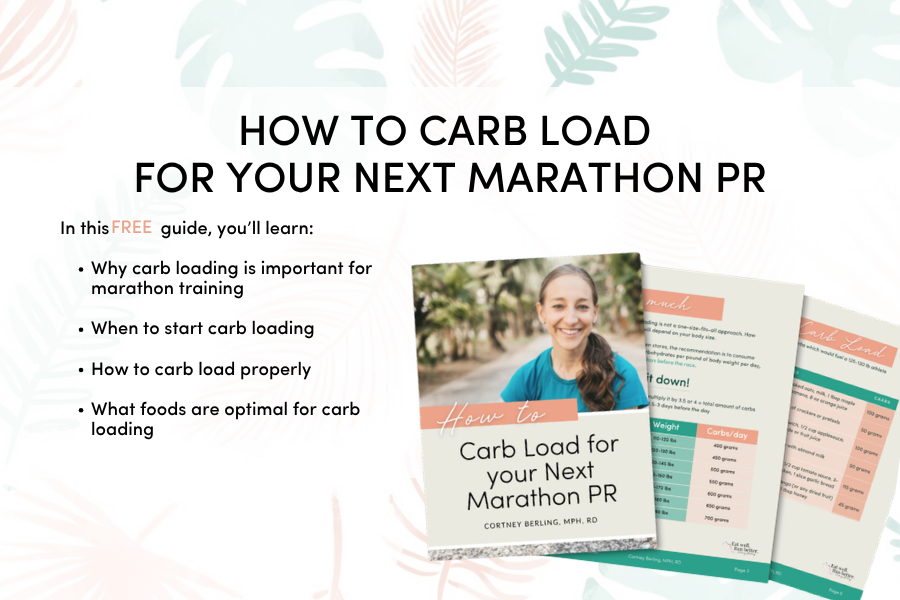
If you want the exact step-by-step protocol I use with my clients, I put it all together in my free guide: How to Carb Load for Your Next Marathon PR.
It walks you through what to eat each day, how to calculate your personal carb needs, and the specific foods that work best for carb loading before a marathon.
What to Eat Before a Marathon
Race morning is where all your preparation meets execution. What you eat in the hours leading up to the start line can absolutely make or break your race.
The goal of your pre-race meal is simple: top off your glycogen stores, give your body accessible energy, and do it all without upsetting your stomach.
2-3 Hours Before the Race
This is your main pre-race meal. Aim 1-3 grams of carbs/kg with a small amount of protein & fat, eaten 2 to 3 hours before your start time.
Examples of a pre-race breakfast:
A bagel with peanut butter and banana
Oatmeal with honey and dried fruit
Two pieces of toast with jam and honey, and a carbohydrate-based drink
A rice bowl with 1 egg
Whatever you choose, practice it during training. I cannot stress this enough. Race morning is not the time to try a new breakfast, experiment with a new brand, or trust that whatever the hotel serves will agree with your stomach.
The meal you eat on race morning should be a meal your gut has already handled successfully on multiple long runs.
10–15 Minutes Before
Taking a final gel right before the start is one of the most underused strategies in marathon fueling. It delivers immediate, usable carbs at exactly the moment your body is about to start burning through them. Practice this during training so your stomach knows what to expect.
Some good options include:
A gel
A few chews
An applesauce pouch
A sports drink
Hydration Race Morning
Start hydrating when you wake up. Don't wait until you get to the start line. Sip fluids steadily through breakfast and up until about 30-40 minutes before the race. Include electrolytes, especially if it's going to be warm. Going into a marathon already dehydrated is a fast track to GI issues and early fatigue.

Fueling During the Marathon
This is the part most runners dramatically underdo. You need more fuel than you think, and you need it consistently.
How Many Carbs Per Hour
Aim for 60–90g of carbs per hour during your marathon. For most runners, that translates to a gel every 25–30 minutes, often paired with a sports drink at aid stations.
This number is higher than what's often recommended for half marathons because the race is longer and the cumulative energy demand is greater. Research has consistently shown that runners who take in higher carb amounts during a marathon perform better and feel better late in the race.
Hydration
Sip small amounts (about 4–6 oz) at every aid station. Don't chug water. It sloshes in your stomach and increases the risk of cramps and GI issues. Alternate between water and sports drink depending on the temperature and how you're feeling.
In warm weather, electrolytes become critical. Sodium loss during a marathon can easily exceed 2,000mg, and replacing some of that during the race prevents cramping and cognitive dips.
The Most Important Rule
Fuel early, fuel often, and don't wait until you feel tired. By the time you notice you're running out of energy, you're already well behind. Set a timer on your watch if you need to. Some runners fuel at every mile marker, others every 25–30 minutes. Find a rhythm that works for your stomach and stick to it.
If gels don't agree with you, chews, waffles, maple syrup packets, and real food options can all work, as long as you've practiced them during training.
What to Eat After a Marathon
Finishing a marathon is an achievement worth celebrating, and your post-race nutrition is part of how you take care of the incredible thing your body just did.
The first 30–60 minutes after a marathon are when your body is most receptive to refueling. Glycogen is fully depleted, muscles need protein to begin repair, and your body is in a significant fluid and electrolyte deficit.
What to Aim For Right After
Within about an hour of finishing, aim for:
20–30g of protein
60–80g of carbs
Fluids with electrolytes
Examples of solid post-marathon options:
A bagel with eggs and fruit
A smoothie with protein powder, banana, and berries
Chocolate milk plus a granola bar and banana
A rice bowl with chicken or tofu and vegetables
A sandwich with deli meat plus pretzels and juice
I know finishing a marathon can leave your appetite all over the map. Some runners are ravenous, others can't stomach real food for hours. If solid food isn't appealing, a smoothie or liquid recovery drink is completely fine. The goal is just to get something in that includes both carbs and protein.
The Hours and Days After
Recovery doesn't stop with your first post-race meal.
Over the next 24–48 hours, focus on:
Focus on balanced, consistent meals (your body is still in repair mode)
Continuing to hydrate and replace electrolytes
Including protein & carbs at every meal to support muscle repair
Sleep, more than you think you need
Most runners massively undereat in the days after a marathon because their appetite is off, life gets busy, or they feel like they should "make up for" the race week carbs. Don't. This is one of the most important windows to fuel well so you can recover, rebuild, and come back stronger for your next goal.

Common Marathon Fueling Mistakes
If you've ever finished a marathon feeling like your fueling didn't quite work out, chances are one or more of these was part of it:
Trying a new food or gel on race day
Carb loading for one meal instead of 2–3 days
Going into race morning dehydrated
Not enough carbs in pre-race meal
Taking too few carbs per hour during the race
Waiting until you feel tired to fuel
Ignoring electrolytes in warm weather
Eating too little the week before the race
Undereating in the days after the marathon
Here's the pattern I see with the runners I work with: once we fix the fueling, the training they've been doing all cycle finally gets to show up. Faster late-race miles. Fewer GI issues. Better recovery. Races that actually match the work they put in.
You don't need to overhaul everything. You just need a strategy that matches the demands of the distance.
Want Ongoing Support for Your Marathon Training?
If this guide helped but you're looking for something more structured to support your body, your training, and your race goals, that's exactly what we build inside the RunWell Collective.
When you join the membership, you'll get:
Training plans for 5K, 10K, half marathon, and marathon distances, with both novice and intermediate options to meet you where you're at
The complete Fuel to Run course + additional learning modules, covering pre-run fueling, carb loading, race day strategy, recovery, and everyday nutrition for runners
Live monthly Q&A calls where you can ask your specific questions and get expert answers in real time
Sample meal plans, grocery lists, and runner-friendly snack and meal inspiration to take the guesswork out of fueling
A private community of runners who actually understand the training and fueling journey, so you never have to figure it out alone
Chat access to me Monday through Friday for support, accountability, and answers between calls
You've done the hard work of choosing a training plan and showing up for your runs. Your fueling deserves the same level of intention.
Ready to stop guessing and start fueling like the marathoner you're training to be? Join the RunWell Collective here, and start training and fueling smarter today.